The financial services sector has reached a critical inflection point, confronting an operational crisis precipitated by the compounding pressures of exponential data proliferation, escalating cybersecurity threats, and the inherent limitations of conventional, manual IT operations. This use case presents a comprehensive analysis of this challenge and details a transformative solution: Artificial Intelligence for IT Operations (AIOps). It provides an in-depth examination of the Netka AIOps solution architecture, a unified system that integrates ITIM, ITSM, and SIEM under an advanced artificial intelligence engine. The document outlines the platform’s five-stage intelligence cycle (Acquire, Aggregate, Analyze, Advise, Action) and demonstrates its real-world application through a high-risk security scenario. The analysis concludes by quantifying the substantial business value derived from AIOps, with a focus on its impact on Mean Time to Resolve (MTTR), operational efficiency, risk mitigation, and the fortification of customer trust.
THE CHALLENGE:
The operational landscape for contemporary financial institutions is characterized by a convergence of critical risks that systemically undermine security, efficiency, and profitability. The traditional, siloed approach to IT and security operations has proven inadequate to address these multifaceted challenges.
- The Global Challenge of Scale and Data Volume: The progression of digital transformation has engendered an immense scale ecosystem. Globally, real-time transactions are projected to increase from 195 billion to 511 billion by 2027 [1], creating a vast and complex attack surface from which new vulnerabilities continually emerge.
- The Global Economic Consequences of Operational Failure: The financial ramifications of operational or security failures have escalated to a level of significance that demands board-level attention. These events represent substantial business risks, not merely technical issues.
- Cost of a Data Breach: A single data breach now incurs an average cost of $6.08 million for a financial institution globally [2].
- Cost of System Downtime: Outages of critical systems lead to direct revenue loss and diminished productivity, with costs estimated to exceed $1,000,000 per hour [3].
- Global Operational Constraints and Human Capital Limitations: The primary line of defense, the Security Operations Center (SOC), is inundated by the sheer volume of alerts from disparate monitoring systems.
- Alert Volume: The average SOC receives more than 11,000 alerts per day [4].
This creates an unsustainable signal-to-noise ratio that results in “alert fatigue,” a critical vulnerability wherein analysts become desensitized to warnings, thereby increasing the probability that sophisticated threats will go undetected.
REGION-SPECIFIC PRESSURES: THE VIEW FROM ASIA AND THAILAND
While these challenges are global, they are acutely intensified in Asia’s rapidly digitizing economies, particularly in Thailand.
- Hyper-Accelerated Digital Adoption: Thailand is a leader in digital payment adoption. In 2024 alone, the country processed over 15.3 billion real-time transactions, a figure expected to grow exponentially [8]. This hyper-adoption creates an environment where security infrastructure development often lags user-facing technology, making Thai financial institutions a principal target for malicious actors.
- Intensified Cyber Threat Landscape: The region is an area of heightened activity for cyber-attacks. Organizations in Thailand report experiencing a significantly higher volume of attacks compared to the global average, with 83% of Thai companies reporting an increase in cyber-attacks in the past year [9]. Ransomware and sophisticated phishing campaigns are particularly prevalent, exploiting trust in mobile-first communication platforms.
- Complex Regulatory Environment (PDPA): Thailand’s Personal Data Protection Act (PDPA) imposes stringent requirements for data handling and breach notification. Non-compliance can result in substantial fines, adding a significant layer of financial and legal risk to any security incident. The cost of a data breach is therefore not just operational but also regulatory.
WHAT IS AIOPS SOLUTION FROM NETKA?
Artificial Intelligence for IT Operations or AIOps from Netka is an advanced solution that leverages big data, machine learning (ML), and automation to enhance and streamline IT and security operations. Instead of relying on siloed monitoring tools and manual analysis, Netka’s AIOps solution provides a central core system that automates the entire process of threat detection and response.

- Acquire: The system collects all types of IT data—like metrics, logs, and alerts—from various sources such as devices, applications, and networks.
- Aggregate: All the collected data is brought together into one centralized platform. This makes it easier to manage, organize, and access.
- Analyze: The platform uses AI-driven algorithms and visualization tools to analyze the aggregated data, helping administrators understand what’s happening and identify issues.
- Advice: The system actively supports IT teams by providing actionable insights, guided workflows, and context-aware recommendations to reduce human error.
- Action: Finally, the platform either recommends or automatically carries out responses to IT incidents, such as sending alerts, triggering events, or implementing solutions automatically.
EXAMPLE USECASE:
The Netka AIOps is an integrated solution designed to automate the entire lifecycle of an IT incident. Its primary goal is to transform a bank’s security from a reactive, manual process into a proactive and automated one. It achieves this by combining data ingestion, AI-powered analysis, and automated responses.
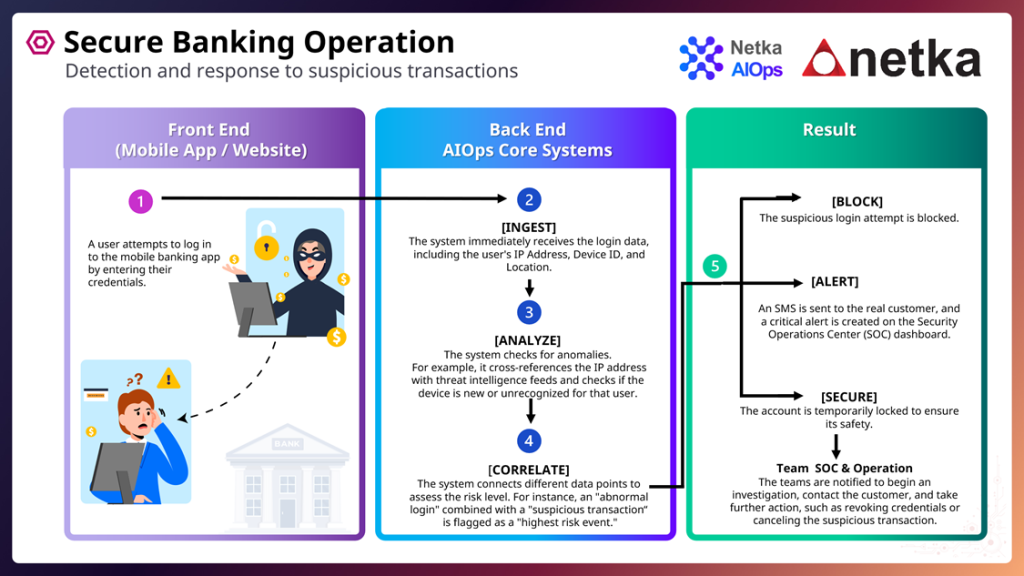
Here is a step-by-step explanation of the flow shown in the diagram:
(Step 1) The process starts when a user attempts to log in to the mobile banking app or website. This action, whether legitimate or fraudulent, is the trigger event.
(Step 2) INGEST: The system immediately collects all relevant data associated with the login attempt. This includes not just the credentials but also crucial context like the user’s, IP Address, their Device ID, and their geographic Location.
(Step 3) ANALYZE: The platform checks this data for anomalies. For example, it cross-references the IP address with global threat intelligence databases and checks if the device is new or unrecognized for that specific user.
(Step 4) CORRELATE: This is the most critical step. The AIOps engine connects different data points to assess the true risk. It understands that an “abnormal login” (from a new device and a suspicious IP) combined with a “suspicious transaction” (like an immediate high-value transfer) constitutes a “highest risk event.”
(Step 5) This step includes several simultaneous actions:
- BLOCK: The suspicious login attempt is instantly blocked.
- ALERT: An SMS is sent to the real customer, and a critical alert is created on the Security Operations Center (SOC) dashboard.
- SECURE: The customer’s account is temporarily locked to ensure safety.
- Team SOC & Operation: Finally, the human security team is notified with all the correlated data, allowing them to begin their investigation with full context and take further action, such as contacting the customer or permanently revoking credentials.
BENEFITS:
- Proactive Threat Mitigation: Shifts security from a reactive, signature-based model to a proactive, behavioral one. It identifies and obstructs sophisticated “zero-day” threats in real-time before they can impact the business.
- Unified Operational Visibility: Dismantles data silos to create a single, correlated view of the entire IT environment, providing unprecedented insight for more informed, strategic decision-making.
- Enhanced Customer Trust: Strengthens customer confidence and brand reputation by proactively protecting accounts and ensuring high service availability, a key competitive differentiator.
RESULTS:
- Drastic MTTR Reduction: Incident response times are reduced from hours or days to mere seconds. This machine-speed neutralization of threats minimizes attack impact, preventing data exfiltration and financial loss.
- Significant Operational Efficiency: Over 90% of routine alert analysis is automated. This yields considerable savings and allows skilled SOC analysts to focus on high-impact investigations instead of mundane tasks.
- Clear Return on Investment (ROI): A clear ROI is achieved by minimizing downtime costs, reducing the financial impact of breaches, and optimizing operational spending through enhanced productivity.
CONCLUSION:
Although the challenges confronting modern financial institutions are profound, they remain surmountable through strategic technological adoption. As this case demonstrates, the implementation of an AIOps platform has transitioned from a forward-thinking option to a contemporary strategic imperative. The Netka AIOps solution furnishes the intelligent, automated, and unified core required to navigate this complex landscape. By transforming IT operations from a reactive cost center into a proactive, data-driven engine for organizational resilience and security, the platform empowers institutions to operate with enhanced speed, intelligence, and security, thereby protecting their most asset: customer trust. In the evolving landscape of digital finance, such intelligent automation is not merely an advantage but the new standard for resilience and market leadership.
REFERENCES
- Global Real-Time Payments Data: ACI Worldwide, “Prime Time for Real-Time Report,” 2023.
- Global Cyber Threat Costs: IBM, “Cost of a Data Breach Report 2024: Financial Industry.”
- Global Downtime Costs: Pingdom, “Average Cost of Downtime per Industry.”
- Global Alert Fatigue Data: Forrester Research, cited by IONIX, “Security Alert Overload: Causes, Costs, & Solutions,” 2024.
- AIOps Market Analysis: Gartner, “Market Guide for AIOps Platforms,” 2023.
- Cybersecurity in Banking: McKinsey & Company, “Cybersecurity: The new pillar of resilience for financial services,” 2023.
- Data Breach Investigations: Verizon, “2024 Data Breach Investigations Report (DBIR)”.
- Thailand Real-Time Payments: ACI Worldwide, “Thailand’s Real-Time Payments Ecosystem Report,” 2025.
- Thailand Cyber Attack Trends: Palo Alto Networks, “State of Cybersecurity in ASEAN Report,” 2024.


